








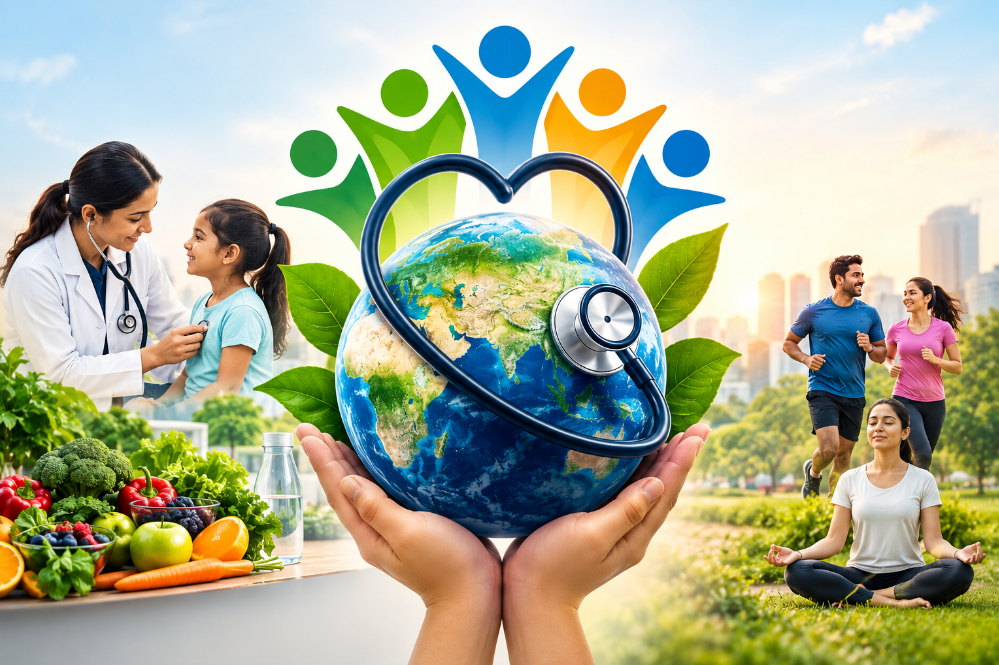
World Health Day is observed every year on 7 April to draw attention to important health issues affecting people around the world. The day also marks the anniversary of the founding of the World Health Organization in 1948. For 2026, the World Health Day 2026 theme is “Together for health. Stand with science.” The World Health Organization has designed this year’s campaign as a year-long effort highlighting the importance of scientific knowledge, international cooperation, evidence-based healthcare, and the One Health approach. The campaign emphasizes how science and collaboration can help protect the health of people, animals, plants, ecosystems, and the planet.
What Is World Health Day
World Health Day is an annual global health observance organized around a particular health topic or message. It provides an opportunity for governments, health professionals, researchers, communities, schools, organizations, and individuals to focus attention on public health.
The observance takes place on 7 April because the date commemorates the establishment of WHO in 1948. Each year, the organization develops a campaign around a health-related priority, encouraging greater awareness and cooperation.
World Health Day can also help explain complex health topics to the public. Through educational activities, public discussions, scientific information, community events, and awareness campaigns, the day encourages people to learn more about health and the factors that influence it.
What Is the World Health Day 2026 Theme
The official theme for 2026 is “Together for health. Stand with science.” WHO says the campaign celebrates scientific achievements and the international collaboration needed to turn evidence into practical health action.
The theme has two closely connected ideas. The first is working together for better health. The second is recognizing the role of science in understanding health problems and developing effective solutions.
The campaign calls on governments, scientists, health workers, partners, and the public to engage with evidence and science-based guidance. It also emphasizes rebuilding trust in science and supporting solutions based on reliable knowledge.
Why the 2026 Theme Matters
Modern health challenges are often interconnected. Infectious diseases, antimicrobial resistance, climate-related risks, environmental changes, chronic diseases, nutrition, and other public health concerns can affect communities in different ways.
Scientific research helps identify these risks and develop ways to prevent, diagnose, manage, and treat health conditions. However, scientific progress is most useful when evidence can be translated into practical action.
The 2026 campaign therefore emphasizes cooperation between different groups. Researchers generate evidence, healthcare workers apply knowledge in practice, governments develop policies, and communities make decisions based on health information.
This collaborative approach is particularly relevant when health threats cross national borders or involve multiple areas of health.
Stand With Science
A central message of the 2026 campaign is to stand with science. WHO encourages people to engage with evidence, facts, and science-based health guidance.
Standing with science does not simply mean learning scientific facts. It also means understanding how evidence is developed, recognizing the importance of reliable information, and being willing to update knowledge as better evidence becomes available.
For individuals, this can include seeking health information from trustworthy sources and discussing medical concerns with qualified healthcare professionals.
For health organizations and institutions, it can mean supporting research, communicating evidence clearly, and using reliable information when developing programs and policies.
Science and Public Health
Science has played a major role in improving public health. Research has contributed to vaccines, medicines, diagnostic technologies, disease surveillance, sanitation practices, nutrition guidance, and many other advances.
Public health decisions often require evidence from multiple scientific disciplines. Epidemiology, medicine, biology, environmental science, statistics, public health, and social sciences can all contribute to understanding health problems.
The 2026 campaign highlights the importance of translating this knowledge into practical solutions that benefit communities.
Science can also help health systems prepare for future challenges. Surveillance systems, laboratory research, medical innovation, and data analysis can help identify emerging risks and support more effective responses.
The One Health Approach
One Health is an important part of the World Health Day 2026 campaign. It recognizes that the health of humans, animals, plants, ecosystems, and the wider environment are interconnected.
For example, some infectious diseases can move between animals and humans. Environmental changes can also influence disease patterns, food systems, water quality, and other health conditions.
A One Health approach encourages professionals from different sectors to work together instead of treating human health, animal health, and environmental health as completely separate subjects.
This approach is particularly valuable when addressing problems that cannot be solved effectively by one profession or institution alone.
International Cooperation and World Health Day 2026
International cooperation is another major element of the 2026 campaign. Health challenges can spread across borders, making cooperation between countries and institutions important.
WHO has highlighted two major events connected with the 2026 campaign: the International One Health Summit and the Global Forum of WHO Collaborating Centres. The Global Forum brought together scientific institutions from more than 80 countries, highlighting the importance of international scientific networks.
International collaboration can help countries share scientific knowledge, strengthen research capacity, improve preparedness, and develop coordinated responses to health threats.
Role of Healthcare Workers
Healthcare workers are an important part of the campaign because they translate scientific knowledge into practical care.
Doctors, nurses, pharmacists, laboratory professionals, public health workers, researchers, and other healthcare professionals use evidence in different ways. They may diagnose illnesses, recommend treatments, provide preventive care, educate patients, or contribute to research.
The 2026 campaign encourages healthcare professionals to communicate scientific information clearly and help communities understand why evidence matters.
Clear communication can be especially important when people encounter confusing or misleading health information.
Role of Governments and Institutions
Governments and institutions can support science by investing in research, strengthening healthcare systems, and incorporating reliable evidence into public health decision-making.
WHO’s 2026 campaign calls for science-based policies and One Health action. It also encourages institutions to strengthen investment in science and use evidence when making decisions related to health, climate, food, and environmental issues.
Strong institutions can help create systems in which scientific knowledge is collected, evaluated, communicated, and translated into practical programs.
Role of Communities and Individuals
World Health Day is not only for governments or medical professionals. Individuals and communities also have a role to play.
People can participate by learning about health topics, asking questions, checking the reliability of health information, and discussing personal medical concerns with qualified professionals.
Communities can organize educational programs, awareness activities, health discussions, and events that encourage healthy behaviors.
WHO’s campaign also encourages people to share experiences about how science has contributed to their health and to participate in the broader conversation around the campaign.
World Health Day 2026 and Health Education
Health education is an important way to turn scientific knowledge into everyday understanding. Scientific discoveries are most useful when people can understand what they mean and how they may affect their lives.
Schools can use World Health Day to teach students about scientific thinking, disease prevention, nutrition, hygiene, environmental health, and responsible health information.
Colleges and universities can organize seminars, research discussions, awareness programs, and community activities.
Healthcare organizations can also use the occasion to explain common health issues and encourage people to seek appropriate professional advice.
Importance of Reliable Health Information
The digital age has made health information more accessible than ever, but it has also created challenges. People may encounter inaccurate, incomplete, outdated, or misleading information online.
The 2026 theme emphasizes the importance of evidence and facts. Reliable health information should be based on credible scientific evidence and communicated responsibly.
People should be cautious about health claims that promise guaranteed results, discourage professional medical care, or rely mainly on sensational statements.
When making personal healthcare decisions, information from qualified healthcare professionals and recognized health authorities can provide a more appropriate foundation.
Key Points to Remember
World Health Day is observed annually on 7 April.
The official 2026 theme is “Together for health. Stand with science.”
The 2026 campaign focuses on science, collaboration, evidence, and public health.
The One Health approach recognizes connections between human, animal, plant, and environmental health.
WHO encourages governments, scientists, health workers, institutions, and communities to support science-based health action.
Reliable health information can help people make better-informed health decisions.
International scientific cooperation is an important part of improving global health.
Tips for Observing World Health Day 2026
Use World Health Day as an opportunity to learn about a health topic that matters to you or your community.
Check the reliability of health information before sharing it with others. When you have a personal medical concern, discuss it with an appropriately qualified healthcare professional.
Schools can organize science and health awareness activities. Businesses and organizations can encourage employees to participate in educational programs and community health initiatives.
Healthcare professionals can explain evidence-based health information in simple language so that more people can understand it.
Communities can also focus on practical actions related to prevention, healthy environments, access to healthcare, and responsible health communication.
Most importantly, the message of the 2026 campaign can be applied beyond one day. Supporting evidence, scientific collaboration, and informed health decisions can contribute to stronger health systems throughout the year.
Final Thoughts
The World Health Day 2026 theme, “Together for health. Stand with science,” highlights the relationship between scientific knowledge and collective action. WHO’s campaign emphasizes that science can help society understand health challenges, develop solutions, protect communities, and prepare for future risks. The focus on One Health also demonstrates that human health is connected with animal health, environmental conditions, ecosystems, and the wider planet. World Health Day 2026 provides an opportunity for individuals, healthcare professionals, researchers, governments, and communities to learn, share reliable information, and support evidence-based approaches to health.
Frequently Asked Questions
1. What is the theme of World Health Day 2026?
The official theme is “Together for health. Stand with science.” WHO says the campaign focuses on scientific collaboration, evidence-based action, and protecting the health of people, animals, plants, and the planet.
2. When is World Health Day 2026?
World Health Day 2026 was observed on 7 April 2026. The date also marks the anniversary of the founding of the World Health Organization in 1948.
3. Why is science important to the World Health Day 2026 campaign?
Science provides evidence that can help researchers and healthcare professionals understand diseases, develop interventions, improve prevention, and strengthen health systems. The 2026 campaign encourages people and institutions to use reliable evidence in health-related decisions.
4. What is One Health in the context of World Health Day 2026?
One Health is an approach that recognizes the interconnected health of humans, animals, plants, ecosystems, and the environment. It encourages collaboration across different disciplines and sectors to address complex health challenges.
5. How can people participate in World Health Day 2026?
People can participate by learning about health and science, checking health information carefully, sharing reliable information, discussing health concerns with qualified professionals, and supporting science-based approaches to public health. WHO also encouraged participation in the campaign conversation through #StandWithScience and #WorldHealthDay.